By Josh Peacock In Events | April 2026
Recap: Support Driven Los Angeles Summit
We enjoyed two days full of strategy-level conversations with the Heads of Support and other CX leaders charged with leading modern support organizations.
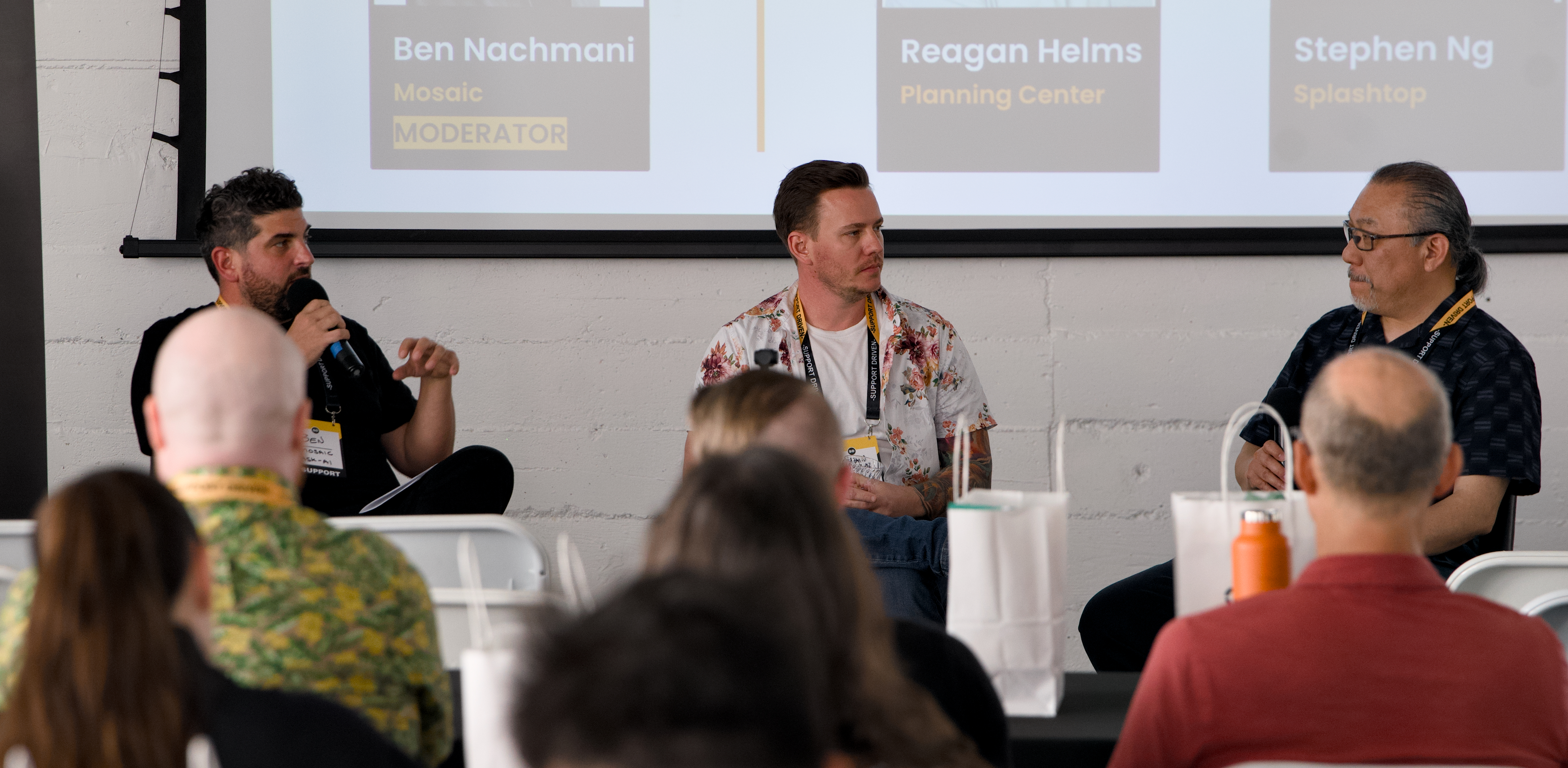
We had a great two days in Los Angeles at the Support Driven Summit, spending time with Heads of Support and CX leaders who are genuinely wrestling with what it means to run a modern support organization. The event created a space for candid conversations and the kind of peer-level honesty you get in a room full of people navigating many of the same realities. From scaling automation to protecting human connection and proving support’s value at the executive level, the conversations reflected the complexity — and opportunity — of leading modern support organizations.
We’re incredibly grateful to the outstanding lineup of speakers who brought such generosity, candor, and depth of insight to the stage. Their willingness to share real-world lessons — the wins, the challenges, and everything in between — is what makes gatherings like this so valuable. Below are a few of the sessions that particularly stood out to us.
PAUSE and Transform Every Customer Conversation
Presented by: Mike Corry
In an AI-accelerated environment where responses can be generated in seconds, Mike made a case for slowing down — just slightly. His PAUSE framework is a simple practice: before you hit send, pick up the phone, or jump into chat, stop long enough to understand the outcome your customer is actually trying to achieve. It sounds small. The impact isn't. Better rapport, better de-escalation, stronger long-term trust. Intentional communication becomes a real differentiator when automation sets the default speed.
The Human Protocol: AI Frameworks That Build Trust and Teams
Presented by: Mykel Salomon
AI initiatives don't fail because of the technology — they fail when teams feel excluded from the future being built around them. Mykel’s session explored a framework for deciding what to automate, what to protect, and how to thoughtfully redesign roles. The emphasis was on transparency and alignment — involving teams early so AI transformation feels collaborative rather than imposed. Leaders walked away with a clear lens for evaluating automation decisions and ensuring that technology amplifies human capability instead of quietly diminishing it.
Designing Support Strategy Before the Data Exists
Presented by: Lala Mamedov
A lot of support leaders are waiting for the perfect dashboard before they'll commit to a strategy. Lala challenged that instinct pretty directly. When you're launching a new product, entering a new market, or scaling fast, the data simply isn't there yet — and waiting for it means operating without a rudder. Her question-driven framework gave leaders a way to clarify assumptions, define desired outcomes, and intentionally design support systems from the start. Strategy isn't a byproduct of data; it's what makes meaningful data possible in the first place.
Support is a Growth Engine
Presented by: Kenji Hayward
Every support ticket carries a signal — about adoption friction, churn risk, expansion opportunity. Most of it never leaves the queue. Kenji's session focused on making that invisible work visible, specifically how to translate support metrics into the language of business outcomes. When support leaders can connect their team's daily work to retention and revenue, the conversation inside the organization shifts. Support stops being a cost narrative and starts being a contribution one.
How Support Insights Can Power Revenue and Retention
Presented by: Michelle Dizon, Alyssa Medin
Building on a similar theme: support teams sit on some of the richest customer data inside any company, and most of it goes underused. Michelle and Alyssa walked through how Fathom operationalizes that data across Customer Success, Product, and Education — identifying onboarding friction, catching early churn signals, informing what gets built next. When support insights are organized intentionally, they stop being reactive service metrics and start functioning as leading indicators of growth.
Managing 10,000 Tickets a Month With Empathy and Engineering
Presented by: Ugo Balducci
Automation at scale requires engineering discipline, not just AI enthusiasm — and Ugo delivered on that. His framework for responsibly automating high-volume support environments covered guardrails, human-in-the-loop workflows, and the knowledge foundations that make automation actually work. The takeaway we kept coming back to: well-designed automation doesn't replace empathy, it creates space for it by removing repetitive work and letting agents focus on the interactions where judgment and nuance actually matter.
When AI Empties the Queue and Raises the Stakes
Presented by: Lihi Shadmi
As AI resolves more routine questions, the nature of the remaining work changes. The tickets left in the queue tend to be complex, technical, and highly contextual — exactly the ones that are hardest to get right. Lihi's session explored the operational shift required when automation reduces volume but increases complexity. The case she made for replacing static knowledge bases with dynamic context engines — systems that surface relevant customer history in real time — was one of the more practically actionable things we heard all week.
The Cost of Being Too Nice
Presented by: Ryan Klausner
Refunds and reships feel like customer service gestures. Ryan reframed them as financial decisions — and the distinction matters. His talk challenged leaders to design thoughtful guardrails that protect margin without eroding trust. Empowerment doesn't mean unlimited discretion; it means giving frontline teams clear principles so they can make good calls in the moment. Generous by design, not unlimited by default.
Turning Ecommerce Customer Questions into Loyalty & Growth
Presented by: Todd Benton
Recurring questions in the support inbox aren't just noise — they're signals about friction in the product or experience. Todd's session showed how systematically capturing and categorizing those questions can inform product decisions, onboarding improvements, and marketing messaging. The best growth insights may already be sitting in your queue.
How Great Careers Are Intentionally Built
Presented by: Alex Davison
A good reminder that careers don't follow straight lines — and the best ones are built on stories, not status. Alex encouraged support professionals to think beyond titles and traditional promotion paths, and to seek out meaningful problem ownership instead. In a landscape where AI is reshaping workflows fast, intentionally building experiences and skill sets isn't optional. It's how you stay relevant.
The Mindset Shift That Transforms Teams
Presented by: Ben Meredith
A lot of organizational problems persist because the way they're defined goes unexamined. Ben's session pushed leaders to slow down before jumping to solutions and spend more time on how the problem itself is framed. Better questions unlock better strategies — sometimes without changing anything else. A short session with a long tail.
How Brands Win or Lose in an Automated World
Presented by: Marlene Summers
As automation becomes standard, differentiation shifts to brand experience. Marlene's session gave leaders the financial frameworks and executive-level language to make that case inside their organizations — shifting the support conversation from cost-cutting to brand differentiation. Human support, done well, contributes directly to loyalty and long-term customer value. That's a story worth telling upward.
The Big Takeaway
AI is accelerating workflows and raising the bar for operational maturity. But the story isn't automation alone — it's what great leaders are doing alongside it: building strong knowledge foundations, designing thoughtful guardrails, empowering their teams and making the business case for support's contribution to growth.
The future of support is proactive, data-informed, and — even as AI takes on more of the load — deeply human. That came through loud and clear in LA.
See you at the Support Driven Expo in Chicago! 🙌